
Complete treatment
One crisis. Three worlds. Billions of necessary voices.
A Treatment
We thought intelligence was something you built. It was something you joined.
Submitted to the XPRIZE × Google Future Visions Competition
Optimistic Futures — The Promise of Artificial Intelligence
Genre: Hard Science Fiction / Optimistic Speculative Drama
Format: Feature Film · Treatment
A Starfinity Studios Production
Created and written by Cj TruHeart
The invitation continues at yspace.media
Logline
After a catastrophic solar storm cuts Earth, the Moon, and Mars off from one another, every attempt to reconnect humanity fails and a powerful founder is forced to surrender the one thing he has spent a lifetime refusing to give up: control; only when an iconic musician stranded aboard a crippled spacecraft broadcasts an unfinished song does an overlooked architect's sovereign AI network come alive, turning billions of frightened people into one rescue team.
The Promise
Forty years from now, humanity did not collapse. Clean energy, autonomous fabrication, regenerative agriculture, and AI have loosened scarcity's grip. People live well on Earth, beneath the lunar regolith, and in a thriving city on Mars.
For billions of people, this future is no longer a promise. It is home.
Humanity's most consequential company is COLONY, builder of the ships, autonomous robotics, and planetary infrastructure that made permanent life on Mars possible. COLONY also owns YSPACE, the social network through which billions watch the age unfold. Its founder, Marius Vega, has become the face of human progress.
Far from the spotlight, Catalina Solano has helped build another kind of power. In Buenos Aires, treaty-backed AI systems allow nations, communities, and institutions to work together without giving any one government or company control. The system translates across languages and disciplines, traces every claim to its source, reveals disagreement, and tests possible plans. It does not decide for people. It helps them hear one another clearly enough to decide together.
That distinction becomes the difference between survival and extinction.
Human First. AI Augmented. The storm separates humanity. Intelligence, rightly built, helps people find one another again.
Principal Characters
Catalina Solano — the architect who learns to invite
An Argentine systems architect in Buenos Aires: restrained, exacting, and more comfortable repairing a protocol than entering a room. Catalina has spent years building a way for different forms of intelligence to cooperate without surrendering their independence. She believes a transparent, well-designed system should earn trust on its own. Her crisis begins when she discovers that building a door is not the same as making people believe they are welcome to enter it.
Marius Vega — the visionary who learns to let go
Founder and CEO of COLONY. Millions are alive because Vega built what others called impossible. But achievement has hardened into a private conviction: progress flows from the person strong enough to hold the whole vision. To save the civilization he helped create, he must release ownership of his greatness and open the systems that made him indispensable.
Yuna Seo ("YUNA") — the artist who leaves room
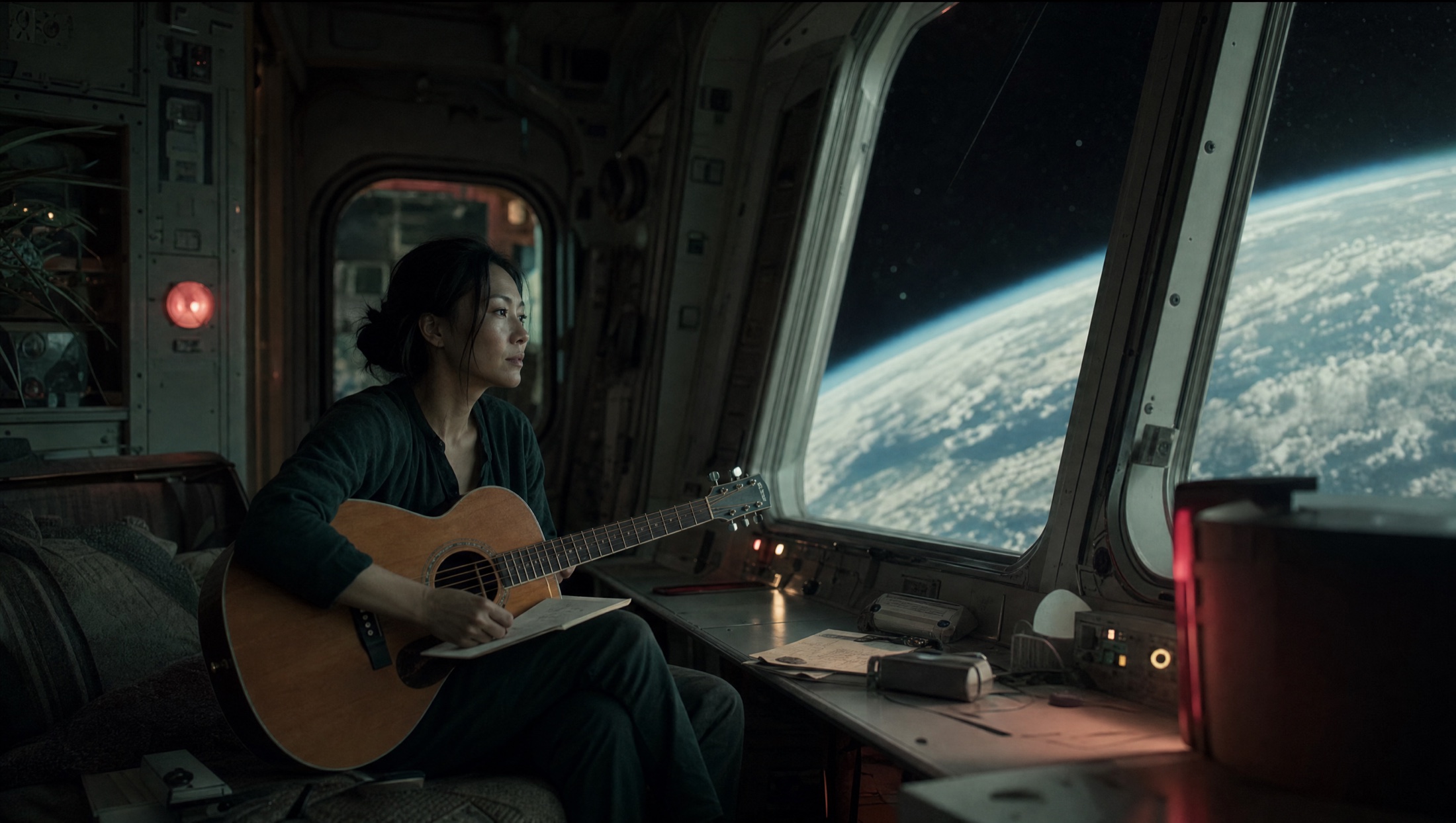
A Korean musician with a planet-spanning audience, traveling aboard Relentless. Yuna knows a song does not belong only to the voice that begins it; it becomes real in the space between the singer and those who hear it. The songs that matter leave room for the listener to answer. After years of watching YSPACE turn her life into content, she refuses to package catastrophe as performance. When she finally sings, she does not deliver an anthem. She leaves the song unfinished so the world can enter it.
Nadezhda "Nadia" Morozova — the keeper who learns to transmit
A Russian relay engineer at the Moon's south pole. Years of emergency repairs live partly in Nadia's memory because her institution rewarded keeping the system alive, not teaching others how. When the relay becomes the last thread between worlds, she must save it by doing what heroic systems rarely reward: making herself replaceable.
Dr. Uchenna "Uche" Obi — the expert who learns to listen
A Nigerian systems biologist on Mars, brilliant and accustomed to being the expert in the room. Crisis asks something harder of her: to turn growers, scientists, sanitation workers, cooks, technicians, elders, and children into a living sensor network — and to recognize a fragment of the answer wherever it appears.
The Story
Act One — The World of One
Opening · The World of One
Robotic systems fabricate precision components inside a vast COLONY manufacturing complex. Nearby, Marius Vega stands alone in the ordered symmetry of a data center, overlooking the computational machinery behind humanity's expansion. The world he helped build is powerful, elegant, and founded on the belief that intelligence is something to own and command.
We move outward through the civilization that machinery made possible: abundant cities on Earth, permanent life beneath the lunar surface, and a Martian settlement approaching one million residents.
Then Marius addresses the world directly. Behind him, a luminous HUD opens across the Martian landscape as the camera slowly closes the distance. He tells billions that Mars is home to 999,999 permanent residents — one soul short of a million. COLONY has reserved the final place for its founder. He will board Relentless, the company's forty-second interplanetary transport, and close the gap himself.
It is a beautiful future, alive and abundant. Yet its oldest story remains unchanged: history belongs to the singular hero.
The cameras find another famous passenger boarding Relentless — YUNA, traveling to see Mars with her own eyes. Vega commands attention from a stage. Yuna's music travels sideways, person to person. Two different theories of influence enter the same ship.
Buenos Aires · The Invisible Architecture
Catalina Solano leads an international delegation through the sovereign agent hall in Buenos Aires. Chinese compute hardware, American foundational models, African and Latin American public-data trusts, lunar telemetry, and thousands of local systems can cooperate here without handing their authority to one owner.
On a display, Catalina shows how the emergency network can translate needs, trace the source of a claim, preserve disagreement, and send unanswered questions toward people who might know more.
A visitor watches the system hold several conflicting models at once. "Which one does it choose?"
"It doesn't," Catalina says. "It helps us ask better questions together."
The delegation praises the famous partners and moves on. Catalina disappears into the machinery she helped create. When a colleague says the public must trust the system before a crisis comes, Catalina answers that transparency should be enough.
She has built a way for the world to connect. She has not yet learned why the world would want to.
The Storm · Three Islands
The Sun erupts with a force surviving records show only once before.
Scientists watch their instruments rise beyond every modern design limit. A vast coronal mass ejection is moving toward the temporary alignment of Earth, the Moon, Relentless, and Mars. A deadly wave of high-energy particles races ahead of it.
There is no villain. Only nature, distance, and systems pushed beyond the conditions they were built to survive.
Aboard Relentless, the crew has one chance to reach the shelter of Mars's radiation shadow. To make the emergency burn, they must shed the ship's landing module. Vega gives the order. Explosive bolts fire. Relentless survives — but loses the only vehicle that could bring its passengers to the surface.
Around Earth, the storm blinds navigation and disables station-keeping across the crowded orbital shell. Satellites collide. Their fragments strike others. A widening cascade turns near-Earth space into a moving cage.
Terrestrial fiber and scattered high-orbit relays keep Earth talking to itself in broken pieces. Governments, public networks, carriers, and COLONY each hold part of the surviving picture. No one holds enough.
On the Moon, the south-pole relay takes a direct hit. The deep-space network is already failing. The damaged lunar array becomes the last unstable bridge among Earth, the Moon, Relentless, and Mars.
One storm has made three islands.
Act Two — No One Can Hold the Whole
Earth · Everyone Speaking
Earth responds with immense capability and incompatible authority. Chinese fabricators can build what American orbital models can help position. Commercial operators hold telemetry public agencies need. Local communities can see conditions no command center can observe. But permissions, protocols, fear, and ownership keep every piece inside its boundary.
YSPACE fills with official broadcasts, automated warnings, arguments, and spectacle. Everyone is speaking. Almost no one is listening.
Mars · The Experts Fail
As the radiation front reaches Mars, the settlement retreats beneath stone. Then a thermal-control failure destabilizes the engineered microbes that make closed-loop life possible. The cultures that recycle waste and feed the hydroponic system begin consuming oxygen and fouling water.
Uche gathers the senior scientists. Every expert offers a credible answer. Each answer solves one variable and worsens another. Charts multiply while the oxygen margin falls.
Mars has brilliant people. It does not yet have shared intelligence.
Moon · The Last Thread
A proton storm drives the lunar crew deep beneath the regolith. Protocol is clear: shelter, seal the doors, wait.
But the damaged relay must be realigned and rewired by hand. The surviving schematic is incomplete. Years of repairs and unlabeled patches live in Nadia's hands and memory.
If she shelters, the inhabited worlds go dark to one another. If she goes outside, the radiation may kill her.
Nadia begins putting on her suit.
Her first objective is modest: pull one damaged relay element into alignment long enough to pass a single transmission. Restoring the complete relay will require her to remain outside.
Relentless · Who Saved You?
In the crippled ship, Vega does not panic. He becomes more certain. He studies every fragment from Mars, convinced that if he can reach the surface and take command, he can make the pieces cohere.
"They need me down there," he says. "No one else has held the whole thing in their head."
Yuna looks at him. "When the storm came, you didn't save this ship."
He turns.
"The crew did. The engineer who designed the release did. The person who tested it did. You gave one order. Everyone else gave the rest." She lets the failing ship hum between them. "You keep saying you're the only one who can save them. Who saved you?"
For the first time in forty years, Vega has no answer.
Their conversations become the quiet chamber at the center of the film. Vega believes civilization needs the rare person who can carry the whole vision. Yuna knows no song survives by remaining inside its singer. He believes he is the source. She knows she is a connection.
Yet Yuna refuses when officials ask her to "mobilize her audience." YSPACE has spent years turning intimacy into engagement and grief into content. She will not make propaganda simply because the cause is righteous.
Catalina's Call · A Door No One Enters
Catalina sees the pattern. No larger model, nation, or company can solve three crises whose missing knowledge is scattered among millions of people.
She activates the emergency network and sends a precise request across public channels: share observations, capabilities, constraints, and relevant data. The agents will translate contributions, connect related fragments, test possible actions, and return every consequential choice to the people who must live with it.
The call reaches the world.
Almost no one answers.
Governments withhold sensitive data. Experts fear being lost in noise. Ordinary people assume the invitation cannot possibly mean them. YSPACE ranks the request beneath famous faces and the spectacle of disaster.
Catalina has built a perfect door into an empty room.
Watching Yuna reject the official appeal, Catalina sees the contradiction in her own approach: she has built a system for collective intelligence while still trying to perfect it alone. The network can invite everyone, but it cannot make anyone feel necessary. People participate when they understand that the system is incomplete without them.
On the Moon, Nadia forces one damaged relay element into partial alignment. The signal is thin and unstable — enough for one narrow transmission, not enough to reconnect the worlds. Catalina seizes the opening and reaches Vega aboard Relentless.
"What would make them believe we cannot solve this without them?"
For once, Vega does not offer an answer. He turns to Yuna.
"What would make them answer?"
The Song · An Opening in the Dark
Yuna understands that a command will never reach them.
"Give me a live channel. No edits. No sponsor frame. No replay delay."
In an empty service corridor aboard Relentless, Yuna stands before a simple microphone. Exposed conduits and pressure doors recede behind her. The ship hums around her, but no one else is there. For several seconds, she says nothing. Then she sings one unguarded phrase.
The melody rises and stops before it resolves. Yuna leaves a space where the next line should be.
"Show us what you see," she says. "Tell us what you know. Send us whatever piece you have."
In a Caribbean coastal community, a child sings the phrase back, then turns the camera toward a neighborhood antenna missing from the orbital maps. A retired guidance engineer sends an old failure log. A Shenzhen machinist shows a tool that can fabricate a part the official plants dismissed as impossible. Lunar apprentices upload partial diagrams. Farmers, astronomers, pilots, nurses, coders, cooks, sanitation workers, scientists, and children respond in thousands of languages.
Not with opinions about the crisis. With observations. Skills. Limits. Questions for one another.
Yuna begins the song. The world completes it.
The response threatens to overwhelm the channels carrying it. Catalina's network can make the fragments legible, but it needs YSPACE's reach, COLONY's orbital telemetry, and access to the company's fabrication network. Vega's board warns that opening them would expose COLONY's deepest advantages. The decision may be impossible to reverse.
Aboard Relentless, Vega watches the first living map of human response flicker to life across his HUD.
"What do you need?" he asks.
Catalina tells him.
Vega opens the systems. No ranking by fame. No exclusive claim on a solution. Contributors keep credit for what they offer. Local authorities retain the right to refuse. His decision saves no one by itself. It simply removes the hand he has kept around the world's attention.
Catalina faces her own version of the same choice. Her emergency layer was built for approved institutions. A treaty council offers to authorize the bridge only if public contributions pass back through the old hierarchy.
She refuses. Catalina publishes the routing rules, opens participation through distributed keys, and gives communities the power to challenge or fork the system's recommendations. Verification remains. Human veto remains. Her control does not.
The opening image was one man addressing billions. Now YSPACE becomes a night sky of people asking and answering one another.
The company called COLONY finally begins to behave like one.
Act Three — The Constellation
A Map, Not an Oracle
The rescue unfolds on honest clocks: minutes to restore communication, days to stabilize Mars, weeks to open a safe orbital corridor, and months to renew interplanetary travel. Distance does not disappear. Cooperation learns how to cross it.
Catalina's system never announces an answer. It translates testimony, traces sources, connects complementary fragments, reveals contradictions, sends missing questions back into the world, and runs possible plans through independent simulations. Manipulated submissions are quarantined. Minority reports remain visible. Every recommendation carries its evidence, uncertainty, and the names of the humans who must decide.
On the central display, isolated points begin to connect. The operators call the living map the constellation.
No single node contains the rescue. The answer exists only between them.
Earth · A Path Through the Cage
Orbital teams abandon the impossible goal of clearing all near-Earth space. Amateur observations, commercial telemetry, old mission logs, independent models, and new fabrication methods reveal a sequence of brief navigable windows through the debris.
Components are printed in Shenzhen. Control models are refined in California and Nairobi. Observers across continents check the launch timing. Teams in Buenos Aires connect the work and invite independent challenges before any human life is committed.
The first attempt fails safely. A technician finds the hidden assumption. The models update. The second attempt holds.
A thin black path opens through the shining storm of debris. It is the most beautiful image in the film — and no one person made it.
Mars · A Million Sensors
Uche stops asking which expert is right. She asks every habitat team a simpler question: what is different where the runaway culture grows, weakens, or disappears?
A child from the buried garden repeats an observation the adults dismissed: the film never forms on the oldest mineral beds. A sanitation worker has seen the same absence near a recovery loop. A cook recognizes the smell of a familiar fermentation shift. Earthside biologists offer analogues. Martian chemists test them against local water and regolith.
The system reveals a relationship among trace salts, temperature, and microbial competition that no discipline held alone. Uche's team tests it. The first mixture fails. The second stabilizes the habitat without destroying the closed loop that keeps Mars alive.
The settlement survives because its experts became listeners and its residents became participants.
Moon · Knowledge That Outlives the Keeper
Nadia crosses the lunar surface through the proton storm. Her dosimeter climbs as the damaged relay shudders above her.
Below the shielding, a younger technician follows a live reconstruction built from Nadia's helmet feed, her spoken instructions, and the incomplete schematic. Nadia repairs and teaches at the same time.
"Red to the third post, not the second. I never fixed the label. I'm sorry. Watch my left hand."
The AI does not replace what Nadia knows. It helps her transmit it. When her glove begins to fail, the younger technician catches an error before Nadia makes it.
Nadia smiles inside her visor. The relay no longer depends on her alone.
She completes the repair and is pulled beneath the shielding alive. The signal steadies. Earth, Moon, Relentless, and Mars hear one another again.
A Civilization, Not a Declaration
The film does not end with leaders announcing unity. We watch cooperation become ordinary.
A relief launch threads the new corridor toward the Moon. Mars sends a cargo vehicle to rendezvous with Relentless. Months later, interplanetary traffic resumes. The lunar relay runs on shared, continuously tested knowledge. YSPACE keeps its public-interest mode and publishes the rules that shape what people see. COLONY's logistics network becomes one participant in an accountable commons rather than its owner.
Nations remain. Disagreement remains. No single global mind is created. Humanity becomes connected without becoming uniform.
Vega reaches Mars at last, not as the conqueror who completes the million, but as one returning citizen among many. The counter has already rolled past its milestone. No one is watching it. There is no stage.
A crew member asks where he wants to go.
Vega looks toward the unloading line. "Where do you need me?"
Yuna's transmission passes into culture, no longer the song one star sang to the world but the song the world finished. Catalina does not take Vega's abandoned stage. She walks through the Buenos Aires hall and pauses beside a public gallery, listening as strangers challenge one of the constellation's assumptions.
The system works because it can be questioned. That is now what she wants.
The Horizon · Something Is Coming
At an Earth observatory, a deep-space telescope reconnects to the shared network and turns toward the stars. Its first restored image belongs to everyone at once.
Something resolves in the darkness: a vast unidentified object, too structured to be natural, moving toward the inhabited worlds.
The old story would end in terror, secrecy, or a leader promising protection. This one does not. The image is released. Scientists disagree in public. Children watch. Translators open channels. Questions move through the same human network that has just survived its first true test.
On the Moon, Nadia stands beside the restored relay and looks toward the stars. Sunlight crosses her gold visor.
Humanity does not know what is coming. For the first time, it may be ready to meet the unknown — not because one mind holds every answer, but because a species has learned how to ask, listen, test, and act together.
Nadia is the final human image.
The screen gives way to CONSTELLATION: a dark world ringed by light, with smaller worlds held in the surrounding field.
We are no longer islands. Good — because something is coming.*
Why This Future, and Why Now
Constellation offers an optimistic vision of AI without making the machine an oracle or humanity its passive audience. AI helps people translate, question, verify, simulate, and find one another. It preserves disagreement and remains answerable to those who live with its consequences.
The decisive acts stay human. Catalina asks. Yuna invites. Vega relinquishes. Nadia teaches. Uche listens. Communities test. Workers build.
AI does not become humanity's mind. It helps humanity think together without asking anyone to become less human.
This is not a finished utopia. It is a civilization learning to meet the unknown through relationship rather than isolation — and discovering that between us, we may already hold what we need to build the future.
Starfinity Studios
Treatment — Submitted to the XPRIZE × Google Future Visions Competition